In 2021, Israeli archaeologists announced the discovery of a woven basket, nearly perfectly preserved, inside a cave in the Judean Desert. The basket held roughly 92 liters, woven from plant fibers, sealed with a lid. Inside, nothing but a thin layer of sand. Carbon dating placed it at approximately 10,500 years old, from the Pre-Pottery Neolithic period, before humans even knew how to fire clay into vessels.
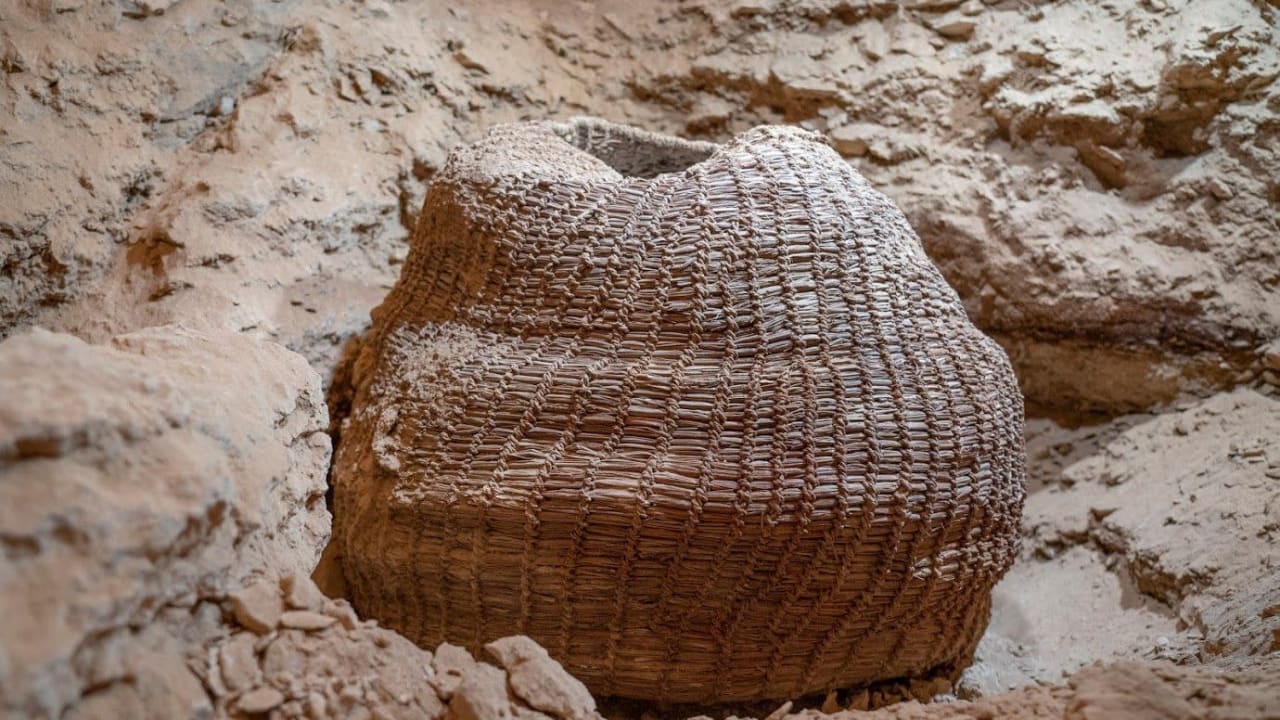
(Source: A 10,500-year-old basket discovered in Muraba‘at Cave by Yaniv Berman/IAA)
What caught the researchers' attention were the traces left on the basket's walls. Two people had woven it together, and one of them was left-handed. From the direction of the twist, the tension of each pull, the angle of each braid, scientists could read the bodily habits of the maker across a gap of ten thousand years.
Weaving is one of the oldest techniques humans have ever developed. Before we learned to shape clay into pots, before we learned to spin fiber into cloth, we already knew how to take strands and interlace them into form. The earliest traces of weaving activity were found on clay fragments at the Pavlov site in the Czech Republic, dating back roughly 25,000 years BCE. In North America, woven baskets from the Great Basin region are over 11,000 years old. Chinese bamboo baskets have been dated to more than 7,000 years ago. In Egypt, baskets followed the dead into their tombs.
Each region chose a different material. The Japanese and Chinese worked with bamboo. West Africans braided palm leaves and local grasses. The Spanish wove with willow. The Vietnamese used rattan, bamboo, and water hyacinth. But the core gesture remained the same everywhere in the world. Take thin strands, thread them through one another in a set pattern, repeat until the loose fibers become a continuous surface, then bend that surface into a volume capable of holding something inside.
This gesture is simple enough for anyone to understand. Yet complex enough that after 10,000 years, no machine has fully replaced the human hand across every variation of it.
When this technique was transferred to tanned leather, the difficulty changed entirely. Leather, unlike bamboo or rattan, is an organic material whose surface and thickness are never uniform. On a single hide, the back is thicker than the belly, the shoulder stiffer than the flank. Each strip, once cut, has its own character, and the craftsman must sense these differences through their fingertips with every pass of the weave.
In the Veneto region of northeastern Italy, leather weaving acquired a name, intrecciato, drawing inspiration from the ancient basket-weaving traditions of the area. The story began in the late 1960s, when workshops in the region only had sewing machines designed for fabric, not strong enough to stitch thick leather. The solution was to cut leather into very thin strips and weave them together, soft enough to pass through the machines while creating a surface stronger than a single sheet of leather. This technique eventually became the signature of an entire luxury fashion house and spread across the global fashion, furniture, and high-end accessories industries.

(Source: A close-up of the Intrecciato leather weaving process and the Bottega Veneta bag.)
But while the name has Italian origins, the essence of leather weaving belongs to anyone willing to sit down and do it. Because leather weaving, like every other form of weaving across history, ultimately comes down to one thing. Hands, material, and time.
At Gallery de Neyuh, our fascination with woven leather patterns has not faded since 2016. Over the years, we have experimented, refined, and developed different weaving motifs. Each motif is a rearrangement of the threading sequence, a change in strip width, an adjustment of the spacing between each intersection. They may look similar at first glance, but each variation produces an entirely different surface in terms of visual rhythm.

(Source: The handwoven leather basket from Neyuh Home & Travel)
The woven leather basket you see here is one of the latest products from Neyuh Home & Travel. A cylindrical form, its rim lined with smooth leather, two handles cut directly into the body. The diagonal weave with large diamond-shaped intersections creates a surface with real depth, where light falls across each woven cell at different angles, bright here, shadowed there, making the entire body of the basket appear to shift gently even though it sits perfectly still.
To keep the basket standing firm like this, we use two layers of leather. An outer woven layer creates the pattern, an inner layer holds the structure. With only one layer, the basket would soften and collapse under gravity. Two layers allow it to stand upright, holding its shape even when completely empty inside.

It takes many continuous hours of work for an artisan to complete the woven panel for a single basket. Natural leather, as noted, is never uniform. Across a single hide, the thickness changes from one area to the next. If the craftsman's hand is not sensitive enough to adjust the pulling tension at each pass, the weave will loosen in one spot and tighten in another, and the entire panel loses its evenness. Technique can be taught. But the sensitivity at the fingertips takes a very long time to develop.
Once the woven panel is finished, the assembly of the body and the edge painting of the rim are the next steps before the basket takes its final form.

The basket you see here is also not the first version. Before it came the rejected ones, the weaves that were not tight enough, the proportions that were not quite balanced, the details that perhaps only we would notice were not right. Most of the time spent making a handcrafted product is not in the production itself. It is in the negation, in looking at something you have just made and deciding that it is not good enough.
We are still not fully satisfied with everything we make. And perhaps that dissatisfaction is the most valuable thing a handcraft maker can hold on to.

Back to the 10,500-year-old woven basket in the Judean Desert cave. Archaeologists believe the person who wove it most likely did not live in the cave but used it only for storage. The basket was completed, sealed with its lid, placed in a dark corner, and left there for 10,000 years with no one coming back for it. No one knows why the weaver never returned. But the basket remained, intact, still holding the shape that a pair of hands had given it.
Ten thousand years ago, someone sat down, took strands, threaded them through one another, repeated the motion until they had an object sturdy enough to hold something that mattered. That gesture, at its core, has not changed.