I happened to stumble upon an article by Eryca Green—a photographer and co-owner of Smith Street Bazaar—sharing her living space in Melbourne, Australia, on the Never Too Small blog. She walked through a stage of her life where she accepted letting go of square footage to find the profound meaning in the details of daily existence. Her mindset shifted from "Surely I couldn’t be happy here? Where would I put everything I had so carefully (and carelessly) collected over the years? How could I make this cramped 'box' uniquely mine?" into a journey of purposeful "input" and "output."

(Eryca Green, photographer and co-owner of Smith Street Bazaar, in her curated Melbourne apartment, Never Too Small)
Many people find living in an apartment of just a few dozen square meters suffocating. That is certainly true if you maintain the lifestyle of someone owning a palace. Living small is like learning to brew a perfect cup of Espresso: you have to compress it tightly, filtering out the diluted water to retain the most refined essence.
As it turns out, when floor space is no longer generous, you begin to develop a peculiar relationship with small, miscellaneous items.
Take the desk, for example. I used to have a desk so large it could hold everything from a computer to stacks of old magazines I never read. Now, everything is encapsulated on a light-colored wooden surface. To keep it from becoming a mess, I placed a leather stationery tray from a craft workshop. It’s just large enough for a signature pen, a few set squares, some paperclips, and two rolls of tape—for those days of random doodling. Yet, every time my hand touches the smooth, cool leather, I find myself significantly more focused. Instead of a cheap multi-compartment plastic box or a heavy metal block, I’ve replaced it with a bit of raw wood wrapped in leather. It sits there, resilient, keeping tiny trinkets in place and preventing my mind from drifting too far from my core goals. Objects with such intent and weight (both literal and figurative) radiate a powerful energy within a narrow space.

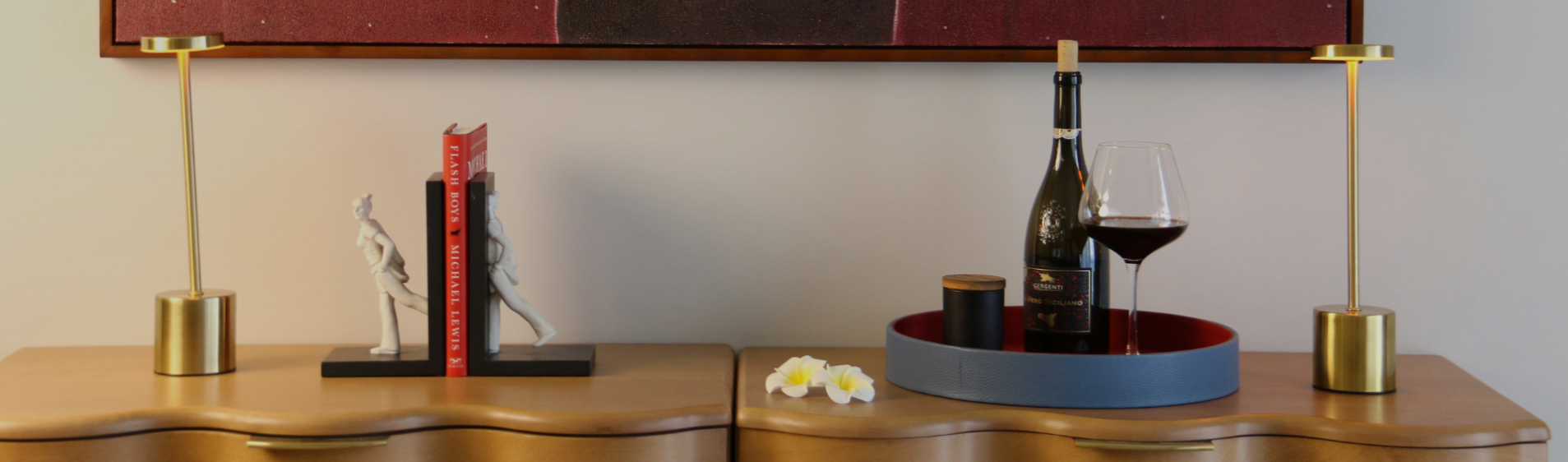
Then there is the matter of light. In a large house, you flip a ceiling switch and the whole room brightens, but it feels cold. In a small apartment, we play like a cat chasing enticing patches of light—extremely attentive and delighted. A mini table lamp with a brushed brass base by the bed is enough for an evening of reading. Or the way a lemongrass-scented candle in a raw ceramic jar casts shadows upon the adjacent blank wall. Scents and light now become "virtual walls" that partition the space, completely separating the sleeping nook from the kitchen area.
Even dining changes. Instead of buying a 12-piece identical set from the supermarket, I’ve started collecting solitary, hand-painted ceramic plates. Each carries its own story: a gold-rimmed one from a thrift shop, a rough blue-glazed one gifted by a friend.
Living small forces you to become "picky." You begin to notice the sound when placing a leather coaster on the table, or the softness of a cable-knit wool blanket draped casually over a laundry basket. These details may be small, but when placed together with intent, they create an incredibly vivid and distinct world.

The biggest mistake is thinking that a small space limits your vision. In reality, when your hands are no longer busy cleaning and maintaining redundant square meters, your mind has more room to soar. Living small allows us to invest in experiences. We have more budget for trips, quality dinners, or collecting exquisite handcrafted items.
In short, freedom does not lie in how many meters you can run to reach the end of a house, but in how many things you can touch that make you smile in an instant. Living small is, in fact, a privilege—allowing you to be completely surrounded by what you truly love.